

Explore Sand Valley with KJUS
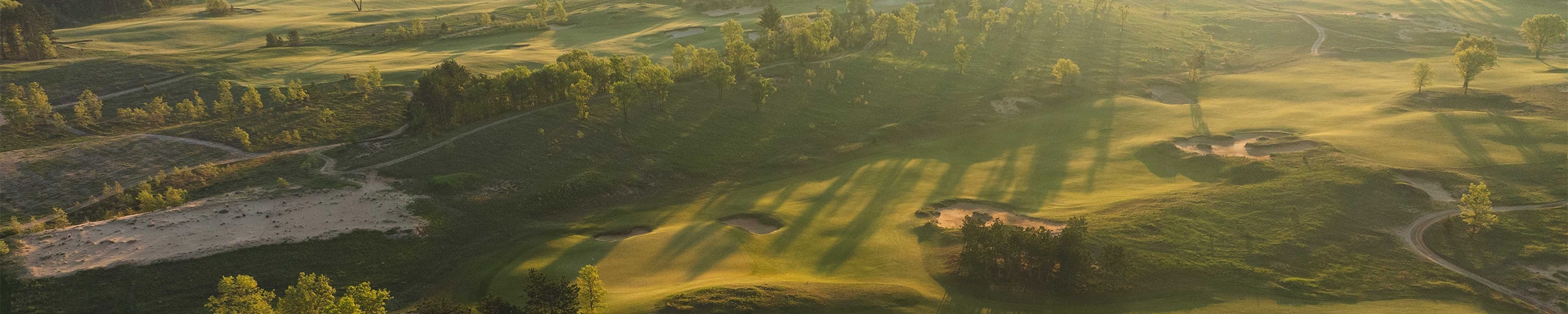
There’s nothing like the way these links smell at dawn. When the sun rises over Sand Valley and the morning dew starts to dry, the air is a mix of fresh cut grass, a hint of wood smoke and petrichor. It smells like golf.

About a dozen years ago, Mike Keiser, already renowned for essentially bringing links golf to the United States with Bandon Dunes, was looking for more than another course. He was joined by his sons. Mike was looking for his legacy. His sons were looking for their first big solo opportunity.
Keiser wanted to build a course that would be ‘in the Top 100 a hundred years from now’. His vision was to create a classic links course, sculpted by the powerhouse Coore & Crenshaw…in the middle of a pine stand in central Wisconsin. Given that the closest ocean was 1,200 miles away, this seemed like a crazy idea.
Keiser had found a piece of land with one of the deepest natural sand basins in the country. It’s essentially an inland sea of sand, a result of the glacial Lake Wisconsin draining in a prehistoric natural disaster. Remove the artificially planted timber and the land undulates like waves. Or more importantly, like heathland.

The Wisconsin Department of Natural Resources and the Chicago Field Museum both supported the development project, as it provided an opportunity to restore the sand barren eco-system to its natural state. Under Keiser’s watchful eye, Coore & Crenshaw team went to work designing in harmony with the natural contours.
Sand Valley’s World-Class Reception
The result is a course that currently holds the No. 15 spot on Golfweek’s 2023 Top 100 Resort Courses list. The following years saw the addition of Mammoth Dunes (David McLay Kidd, No. 16 on Golfweek’s 2023 Top 100 Resort Courses list). Then it was time for the sons to start their solo act with the 17-hole short course, the Sandbox, also by Coore and Crenshaw. The resort offering has been rounded out by Tom Doak’s highly acclaimed, heathland-inspired Sedge Valley. With a glint in their eyes Michael and Chris suggest there are several more courses to come. We have no doubt that they will be world class. Adjacent to the resort is The Lido, a private club, open to those staying at the resort Sunday to Thursday.

The Lido course is the stuff of legend. Designed by Charles Blair Macdonald in 1917, the original course was built on the South Coast of Long Island. During World War II, the US government decided it was more concerned about German U-Boats around New York City than they were with preserving a golf course. The land became an air base, and the course was lost.
Pictures of the course existed, and many a golf architect studied them to try and decipher what magic Macdonald had conjured with the layout, but no one was able to recreate the course in 3D.
Until the discovery of Lidar.
Lidar is a remote sensing method that uses laser light to measure distances to objects. It works by sending out pulses of laser light and measuring the time it takes for the light to bounce back. Using Lidar, the old photographs and other material, an architecture enthusiast named Peter Flory developed a computer simulation of the course. The Keiser brothers had been working on rebuilding the Lido, but it seemed an impossible task. Then came a fateful meeting with Flory. When they saw the computer model, they asked Tom Doak if he could bring The Lido back to life.
Thanks to a GPS topographical blueprint, Doak was able to recreate legendary template holes like Plateau, Alps and Cape within a centimeter of the original course. Doak told Golf Digest that it was only after he actually played it a few times that he was able to truly understand and appreciate the intricacy of the fairway contouring.
Some say that playing The Lido is like a step back in time. You wouldn't ever make a course this extreme today. But, combine it with the charm of Sege, all-consuming Mammoth Dunes, and the classily Coore-Crenshaw Sand Valley and you have 4 remarkably different courses in one location.

You might not think typically of world-class links golfing and cheese curds in the same sentence, but Sand Valley brings together challenging courses and Midwest hospitality, also known as Wisconsin nice. It’s a place where the shuttle driver will show you his favorite corner of the property, where flowers grow to the size of dinner plates in the sandy, glacial soil and where you can watch the sun set over acres of land painstakingly shaped for one purpose: a fine day of golf.
KJUS Gear Made for Sand Valley
A KJUS golf favorite: it is the Midwest, so be sure you’re able to stay dry when the rain decides to visit. Lighter than a sleeve of Pro V1x golf balls, this thin and light rain jacket is great in humid climates.
A KJUS golf vest is ideal if you’re visiting in the spring or fall when temperatures can be frosty, especially in the morning. KJUS insulators are known for their innovative insulation which are very light but regulate your temperature in fluctuating climates.
The atmosphere in the Sand Valley establishments is welcoming but not stuffy, so our short-sleeved polo will be welcome everywhere you go for after-round drinks and dinner.